
How to Choose Embroidery Sheer Fabric for Your Business?
Choosing the right Embroidery Sheer Fabric can influence product quality, customer satisfaction, and profit margins. A fabric may look beautiful under showroom lighting, yet behave poorly during stitching. It might snag, stretch, or lose its shape after washing. Therefore, business buyers should test the material before placing large orders. Small samples reveal practical problems early.
Textile educator Gail Harker emphasizes this principle: “The fabric is the foundation of the embroidery.” Her observation reflects real production experience. A stable base supports clean motifs, balanced tension, and consistent finishing. For example, cotton voile can offer a soft hand and natural appearance. Polyester mesh may provide better durability and dimensional stability. Silk organza creates a premium effect, but it often demands gentler handling. Each option carries trade-offs.
This guide will examine fiber content, transparency, weight, width, embroidery compatibility, and care performance. It will also consider supplier reliability, sample approval, color consistency, and minimum order quantities. These details matter when fabric moves from a sample room to hundreds of finished garments. A low price is not always a saving. Sometimes, it creates waste.
The process is not perfectly predictable. Dye lots can vary. Embroidery density can change the fabric’s drape. Even experienced buyers may overlook seam slippage during a rushed inspection. That is why testing should include stitching, washing, pressing, and repeated handling. The best Embroidery Sheer Fabric is not simply the prettiest choice. It is the material that performs reliably for your specific product, market, and production method.
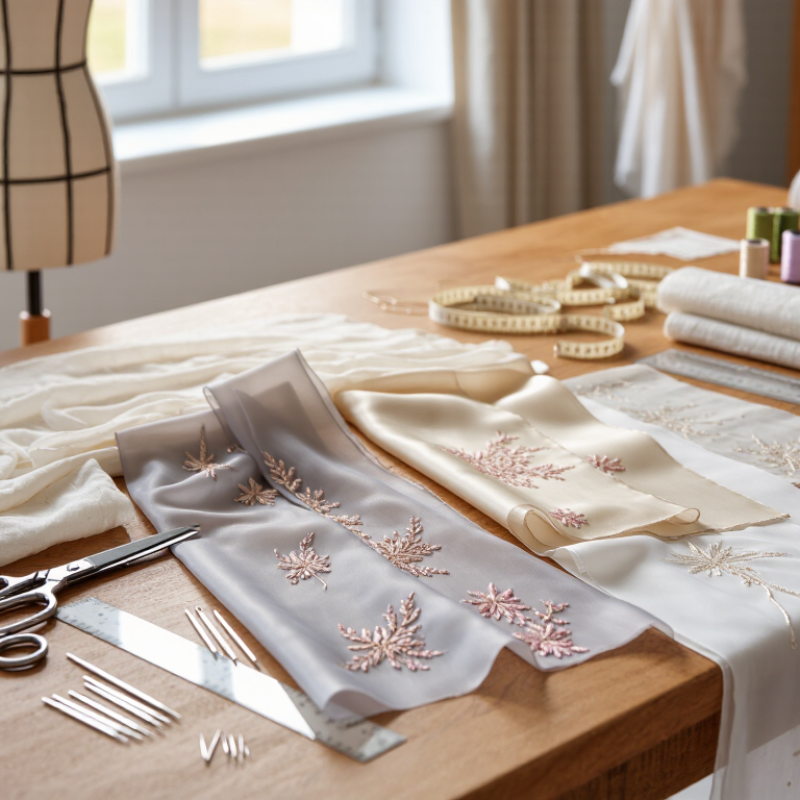
Define Your Embroidery Sheer Fabric Requirements
How to Choose Embroidery Sheer Fabric for Your Business?
Define Your Embroidery Sheer Fabric Requirements
Start by defining the product, customer, and embroidery pattern. A bridal veil needs a softer hand than a decorative curtain. Measure the required width, roll length, and finished weight before requesting samples. Keep it practical. Choose the fiber according to performance, appearance, and care needs. Polyester usually offers stable dimensions and consistent color. Cotton or blended fibers can provide a more natural touch. However, they may shrink more during washing. I learned this after a sample changed noticeably after steaming.
Check the fabric’s openness with a ruler and backlight. Dense mesh supports detailed embroidery, while open mesh creates a lighter visual effect. Confirm the GSM, edge construction, and usable width. These details affect cutting waste and production costs. Test the fabric on your actual embroidery machine. Record thread tension, needle size, hoop marks, and puckering. Do not rely on a supplier’s standard settings. They may not suit your design. Wash, steam, and stretch the embroidered sample before approving bulk production. Inspect color under daylight and indoor lighting. Small differences can become expensive later. A written requirement sheet keeps purchasing, sampling, and production aligned.
How to Choose Embroidery Sheer Fabric for Your Business? - Define Your Embroidery Sheer Fabric Requirements
| Requirement Area | Key Requirement | Recommended Commercial Target | Why It Matters for Embroidery | Suggested Verification |
|---|---|---|---|---|
| Fabric Construction | Sheer base structure | Tulle Mesh Organza Select a stable, evenly woven or knitted construction with no visible holes outside the intended design. | A consistent base helps embroidery machines form uniform stitches and reduces needle deflection, puckering, and distorted motifs. | Inspect the fabric against transmitted light and check a stitched sample at the intended production speed. |
| Fabric Weight | GSM and material handle | Approximately 20–80 g/m² for lightweight sheer applications; confirm the final range according to the design, embroidery density, and end use. | Lower-weight fabrics provide transparency but may require stabilizer support. Heavier sheers generally offer better handling and coverage. | Measure mass according to ISO 3801 or an equivalent textile testing method, then compare the result with the approved sample. |
| Dimensional Stability | Shrinkage and growth control | Set a project-specific limit, commonly no more than 3% lengthwise or widthwise change after the planned care process. | Excessive dimensional change can cause embroidery designs to misalign, distort, or pull away from the surrounding sheer fabric. | Wash or condition the fabric using the intended care instructions and measure before-and-after dimensions. |
| Tensile Performance | Strength and seam support | Use a fabric that withstands hooping, machine handling, finishing, and the expected end-use stress without tearing around the embroidered area. | Very delicate sheers can split at needle holes or along the embroidery edge when stitch density or thread tension is high. | Perform tensile and tear checks using ISO 13934-1 and ISO 13937-2, or an equivalent recognized method. |
| Embroidery Compatibility | Needle, thread, and stitch density | Define the needle size, thread type, stitch count, and stabilizer before bulk production; use a trial panel for every new fabric construction. | Sheer fabrics are sensitive to needle damage, thread tension, skipped stitches, and excessive embroidery density. | Review a production-like strike-off for skipped stitches, puckering, fabric cuts, thread breaks, and design registration. |
| Color Requirements | Shade consistency and transparency | Define an approved color standard, acceptable shade tolerance, and the required level of transparency for each collection or product line. | Small shade differences are highly visible in transparent fabrics, especially when layered or placed over contrasting garments. | Evaluate under consistent daylight and store-light conditions; use instrumental color measurement when a formal tolerance is required. |
| Colorfastness | Resistance to washing, rubbing, and light | Set performance levels based on the product's care label and market. Higher requirements are appropriate for frequently washed or exposed products. | Poor colorfastness can transfer dye to embroidery threads, lining materials, or adjacent garments. | Use relevant tests such as ISO 105-C06 for washing, ISO 105-X12 for rubbing, and ISO 105-B02 for light exposure. |
| Surface Appearance | Uniformity, shine, and defect control | Specify acceptable limits for slubs, laddering, broken filaments, oil marks, wrinkles, and uneven luster before purchasing. | Sheer fabrics reveal surface defects easily, and embroidery can make irregularities more noticeable rather than concealing them. | Inspect rolls under standard lighting and record defect frequency using a documented fabric inspection system. |
| Handle and Drape | Softness, stiffness, and fall | Select the hand feel according to the product: soft and fluid for apparel, or firmer and more structured for decorative panels and accessories. | Handle affects hooping behavior, pleat formation, garment comfort, and the final appearance of embroidered motifs. | Compare the fabric with a signed reference sample and assess drape before and after embroidery and finishing. |
| Finishing and Care | Compatibility with finishing process | Confirm compatibility with washing, steaming, pressing, coating, bonding, and any planned post-embroidery treatment. | Heat, moisture, or chemicals can change transparency, stiffness, shrinkage, and the appearance of embroidered threads. | Run a complete process simulation, including finishing and care, before approving the fabric for bulk production. |
| Compliance and Safety | Restricted substances and product safety | Request current material declarations and test reports appropriate to the destination market, product category, and intended consumer use. | Documentation supports retailer requirements and helps verify that dyes, finishes, and accessories meet applicable safety expectations. | Use an independent laboratory when required and maintain lot-based test records and supplier declarations. |
| Supply and Quality Control | Lot consistency and order planning | Define roll width, usable width, roll length, packing method, shade grouping, inspection level, and acceptable defect limits. | Consistent supply reduces cutting loss, shade variation, machine adjustments, and rework during repeated production runs. | Approve a pre-production sample, inspect incoming rolls, and retain a reference sample from each accepted lot. |
Note: The recommended targets are starting points for product specification. Final requirements should be confirmed through a fabric-and-embroidery trial based on the intended product, care method, and destination market.