
China Best Wall Mounted Display Rack Suppliers?
Choosing among China’s Wall-Mounted Display Racks suppliers takes more than comparing catalogue photos. A rack may look sturdy online, yet feel different when loaded with products. Check the material, finish, mounting method, load rating, and available dimensions. Ask for drawings and close-up images of brackets, welds, and shelf edges. Details matter.
Design researcher Don Norman wrote, “Good design is actually a lot harder to notice than poor design.” His observation offers a useful test for display fixtures: reliable support and easy access should feel natural, not distracting. For a shop owner, that might mean a wall rack that holds packaged goods securely while keeping labels visible and replenishment simple. Small details count.
This guide looks at how to assess suppliers, compare customization options, and ask practical questions before placing an order. It considers sample approval, production communication, packaging, and after-sales support—not just the lowest quoted price. A useful supplier should explain tolerances and installation requirements clearly. Still, specifications do not tell the whole story. A sample can reveal awkward edges or a finish that differs from the catalogue image. That deserves a second look. The best choice depends on your wall, merchandise, and daily workflow, so verify each detail against your actual store needs.
Wall-Mounted Display Rack Basics: Types, Uses, and EN 16121 Scope
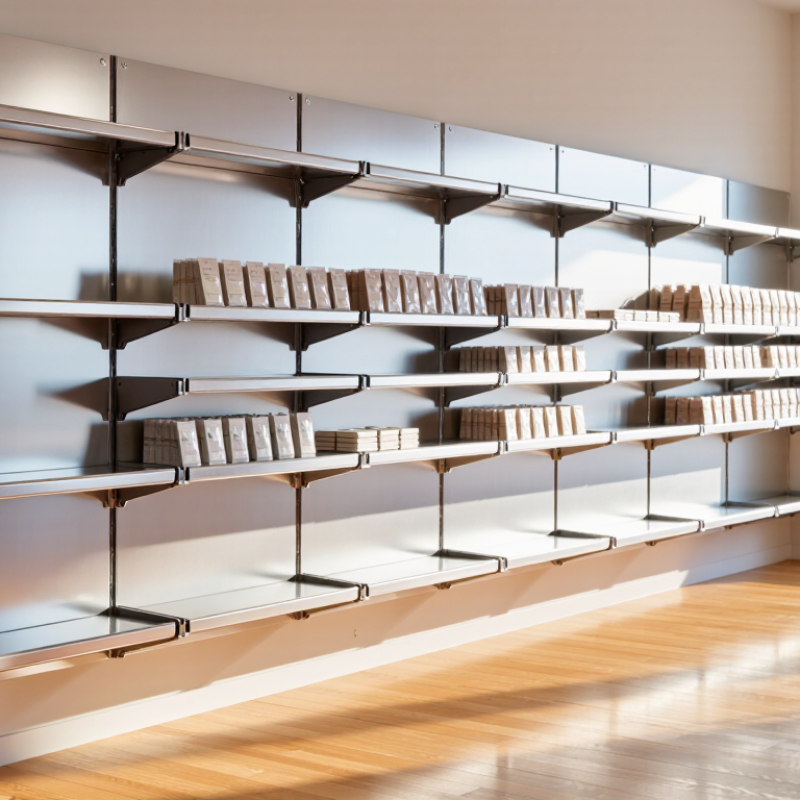
Wall-mounted display racks come in several practical forms. Common options include fixed shelves, slatwall panels, pegboards, and enclosed cabinets. A rail system makes shelf spacing easier to adjust. Pegboards suit small packaged goods and tools. Cabinets protect delicate items from dust and frequent handling.
Use depends on the products, customer access, and available wall space. A display for heavy boxed goods needs different support from one holding lightweight accessories. Check the rack’s stated load, fastener type, and installation instructions. The wall matters too: plasterboard, masonry, and timber studs need different fixing methods. A tidy installation can still be unsafe if anchors miss the supporting structure.
EN 16121 specifies safety, strength, and durability requirements for non-domestic storage furniture within its scope. Whether a particular wall-mounted display rack falls within that scope depends on its intended use and design; the standard should not be treated as a blanket approval for every rack. Ask suppliers for applicable test information and clear load limits. I would also check how those limits were established. A clean-looking chart may omit installation conditions, and that detail is easy to miss.
China Best Wall Mounted Display Rack Suppliers? - Wall-Mounted Display Rack Basics: Types, Uses, and EN 16121 Scope
| Rack Type | Typical Construction | Common Uses | Key Selection and Installation Considerations | EN 16121 Scope Relevance |
|---|---|---|---|---|
| Fixed wall shelf system | One or more horizontal shelves secured to wall brackets, rails, or direct-fix supports. | Retail merchandise, books, packaged goods, and general-purpose display. | Check the stated shelf load and load-distribution conditions. Select fixings for the wall substrate and install them according to the manufacturer’s instructions. | May be relevant when the product is non-domestic storage furniture within the standard’s scope. The standard is not a universal load rating for every shelf or wall. |
| Slatwall or panel-mounted system | Hooks, shelves, or brackets attach to a slotted or grooved wall panel, which is itself fixed to a supporting wall or frame. | Retail displays for products that benefit from adjustable hook and shelf positions. | Consider the complete load path: accessory, panel, panel attachment, and supporting wall. Confirm compatibility and capacity for the specific configuration. | Scope depends on the product and its intended non-domestic use. Testing of a component alone does not automatically establish the performance of the complete installed system. |
| Wall-mounted pegboard display | A perforated panel accepts compatible hooks, bins, or small shelves. | Tools, accessories, small packaged items, and frequently changed displays. | Use compatible fittings and follow the panel’s stated loading guidance. Avoid assuming that capacity is identical across different hole patterns, panels, or wall fixings. | EN 16121 may apply to qualifying non-domestic storage furniture; it does not specify a single capacity for all pegboards or installation substrates. |
| Wall-mounted cabinet with shelves | An enclosed storage unit with doors or open compartments, fixed to a wall. | Back-of-house storage, display of higher-value goods, and areas where contents need protection. | Assess the cabinet, door hardware, internal shelves, fixing points, and wall substrate. Follow the installation instructions and any anti-tip or restraint guidance. | This is a common type of non-domestic storage furniture that may fall within EN 16121, subject to the standard’s scope and product classification. |
| Wall-mounted display ledge | A shallow shelf or ledge, sometimes with a front lip or retaining edge. | Books, framed items, small products, and visual merchandising. | Check usable depth, edge retention, mounting arrangement, and permitted loading. A retaining lip does not replace secure fixing or safe loading practice. | Potentially within scope when designed as non-domestic storage furniture. The standard does not replace assessment of the building wall or the selected anchors. |
| Modular wall rail system | Vertical standards or horizontal rails support movable brackets and shelves. | Retail, stockrooms, and other spaces where shelf positions may need adjustment. | Install rails at the specified spacing and secure them to suitable structural support. Confirm limits for the complete rail-and-bracket arrangement. | Where the system is non-domestic storage furniture within scope, relevant safety, strength, durability, and stability requirements may apply to the product configuration. |
| Glass-fronted wall display cabinet | A wall-fixed enclosure with glazed doors or panels and internal shelves. | Retail or exhibition display of products that need visibility and some protection. | Consider glazing type, door operation, shelf support, unit mass, fixing points, and the manufacturer’s installation requirements. Use suitable handling and installation procedures. | May be covered as non-domestic storage furniture if it meets the standard’s scope. Product-specific glazing and installation requirements may also be relevant. |
| General EN 16121 reference | European standard for non-domestic storage furniture: requirements for safety, strength, durability, and stability. | Used to assess applicable storage furniture intended for non-domestic settings. | Confirm the applicable edition, product category, intended use, and test configuration with the supplier or a qualified testing body. Installation conditions can affect real-world performance. | EN 16121 is not a building-wall or anchor-design standard and does not provide one universal safe working load for all wall-mounted racks. EN 16122 specifies test methods for determining strength, durability, and stability of storage furniture. |
Practical note: Ask for the product’s stated load limits, installation instructions, and any relevant test documentation. Wall material, anchor selection, installation quality, and how loads are distributed all affect the safety of a wall-mounted display.