
Global travel is expanding, but Luggage buyers are becoming more selective. IATA’s December 2024 industry outlook projected 5.2 billion air passengers for 2025. That figure highlights a simple concern: luggage must survive crowded airports, rough handling, and repeated transfers.
Grand View Research estimates that the global luggage market will continue growing through 2030. Its analysis emphasizes rising travel demand, premium materials, and functional design. Carbon Fiber Luggage fits this shift through lightweight shells, strong visual identity, and advanced construction. Yet carbon fiber is not automatically better in every situation. Poor layering, weak corners, or low-quality wheels can still cause early failure. That point deserves more attention.
This 2026 guide examines the leading Carbon Fiber Luggage types for global buyers. It covers hard-shell cabin spinners, larger checked cases, business luggage, hybrid models, and specialized travel designs. Each category requires different evaluation standards. Buyers should check shell structure, wheel durability, telescopic-handle fatigue, zipper quality, and repair support. Airline size limits also matter, especially for international routes with strict cabin measurements.
Independent testing remains valuable. Organizations such as TÜV Rheinland, SGS, and Intertek commonly assess material performance, durability, and product safety. However, certification does not replace practical inspection. A suitcase may pass laboratory testing but feel unstable on uneven pavement. This guide therefore combines published market evidence with real purchasing considerations, including weight, maneuverability, warranty terms, and long-term serviceability. Some premium claims remain difficult to verify. Careful comparison is still necessary.
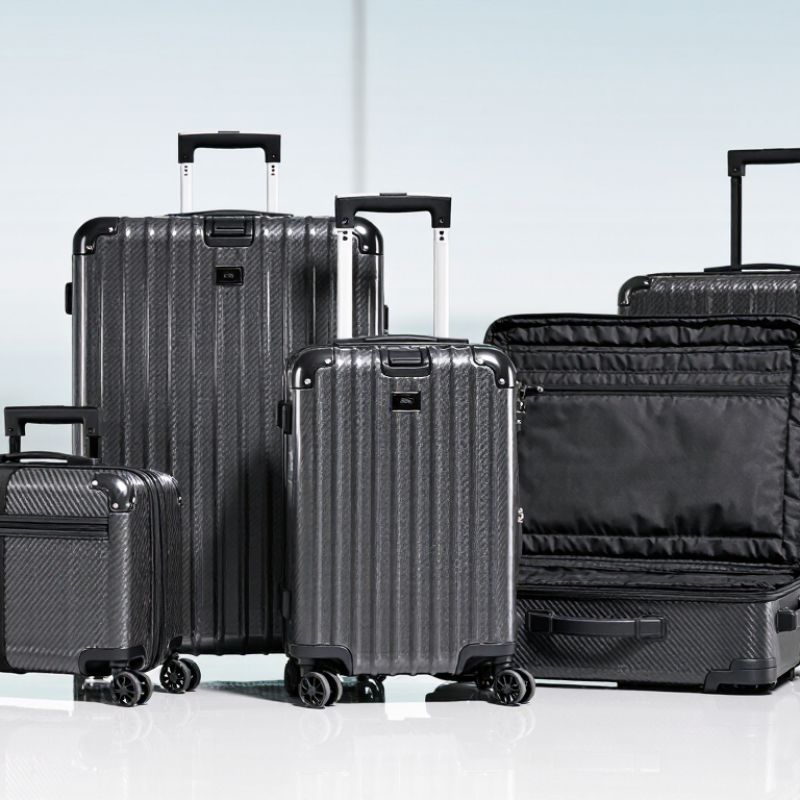
Carbon fiber luggage is built from carbon fibers embedded in a polymer resin, usually epoxy. It is not a solid carbon shell. The fiber provides stiffness, while the resin holds the structure together. Toray technical data places standard carbon fiber density near 1.8 g/cm³, much lower than steel. This creates a strong stiffness-to-weight advantage for frequent travelers.
Grand View Research reports that the global carbon fiber market is expected to expand at about 8.9% annually from 2024 to 2030. This growth reflects demand from transportation, aerospace, and sporting goods. Luggage benefits from the same material logic: rigid panels, lower shell deformation, and good resistance to moisture and corrosion. A well-made shell can feel firm under hand pressure. That detail matters during airport handling.
But carbon fiber is not automatically better. Pure stiffness can reduce impact tolerance when the layup is poorly designed. A hard corner may chip, while a flexible polycarbonate shell may absorb the same force. Repairs can also be more difficult and expensive. Carbon fiber surfaces may show scratches clearly. Small flaws become visible. Global buyers should check fiber orientation, resin quality, wheel mounts, zipper protection, and tested impact performance. Material claims alone are weak evidence. The market data is encouraging, but luggage design still needs practical testing.
International buyers usually compare carbon fiber luggage by structure, not appearance. Most models fall into four practical types: hard-shell carry-ons, checked cases, hybrid cases, and compact cabin bags.
Hard-shell carry-ons suit short business trips, with strong protection for laptops, documents, and folded clothing. Checked cases provide greater capacity for longer travel, but their weight deserves careful attention. Airport weight limits vary by route and carrier.
Hybrid luggage combines a carbon fiber reinforced shell with flexible fabric sections. This design can expand slightly and fit crowded storage spaces. It may also show wear sooner than a fully rigid case.
Compact cabin bags are useful for regional flights, rail travel, and quick overnight trips. Their dimensions should be measured with wheels and handles included. Small differences can cause problems at boarding gates.
In professional product checks, I examine shell thickness, wheel attachment, handle movement, zipper protection, and repair access. Carbon fiber does not make a suitcase indestructible. Poor wheel design can still fail on rough pavement.
A lightweight shell may also offer less impact absorption in cold weather. Buyers should confirm material details, because “carbon fiber” can mean a reinforced composite rather than a fully carbon fiber shell.
No case is perfect. Select the type that matches baggage rules, travel duration, and realistic handling conditions.
Carbon fiber luggage now spans compact carry-ons, medium checked cases, large trunks, and hybrid garment cases. A practical carry-on usually measures near 56 × 45 × 25 cm, matching IATA’s commonly referenced cabin-baggage guideline. However, airlines apply different limits. Buyers should measure wheels and handles, not only the shell.
A 20-inch case generally offers 35–45 liters for clothing, a laptop, and small accessories.
Medium 24-inch cases often provide 60–75 liters
while 28-inch models can exceed 100 liters.
Carbon fiber reduces shell weight and improves stiffness, but internal frames, wheels, and locks still affect total mass.
Capacity claims can also feel optimistic. Compression panels and thick lining quietly consume useful space.
Mobility deserves equal attention. Two-wheel designs roll well across uneven pavement, while four-wheel spinners offer easier movement through terminals and narrow hotel corridors.
SITA’s 2024 Baggage IT Insights reported 6.9 mishandled bags per 1,000 passengers in 2023, showing why reinforced corners and dependable wheel assemblies matter.
A trunk-style case suits long trips, but its larger footprint can complicate storage.
I would not choose carbon fiber by appearance alone. Wheel replacement access, telescoping-handle play, and verified impact testing deserve closer inspection.
Some premium cases remain light, yet awkwardly balanced when fully packed.
2026 buyers should compare carbon fiber luggage by security, durability, and travel compliance. Carbon fiber offers high stiffness with low weight, but it can crack after sharp edge impacts. Inspectors may miss internal damage beneath a smooth shell. SITA’s 2024 Baggage IT Insights reported 6.9 mishandled bags per 1,000 passengers in 2023. Strong wheels, reinforced corners, and replaceable handles therefore matter more than a glossy finish.
Security needs practical details. Choose a rigid frame, tamper-evident closures, and an inspection-compatible combination lock. A sealed compartment can protect documents and electronics from casual access. However, carbon fiber does not make luggage theft-proof. The 2024 IATA Global Passenger Survey showed that travelers increasingly value convenient digital and self-service journeys. A luggage model should support fast inspection, clear identification, and easy recovery after handling errors. Avoid hidden tracking batteries unless they can be removed, labelled, and carried according to current airline rules.
Tips: Measure the case, including wheels and handles. Compare those dimensions with each airline’s published cabin limits. No universal cabin size exists. Check empty weight, wheel replacement, lock access, and repair support. For batteries, follow the airline’s watt-hour limits and keep removable units in cabin baggage when required. Test the handle under load. It may feel solid in a showroom, yet loosen after repeated curb impacts. Carbon fiber is impressive, but imperfect construction still fails. Use independent test evidence, such as drop, wheel-cycle, and impact results, rather than relying on material claims alone.
| Luggage Type | Typical Exterior Size | Typical Capacity | Typical Empty Weight | Best Use | Security Features to Compare | Durability Factors | Travel Compliance Points | Buyer Check |
|---|---|---|---|---|---|---|---|---|
| Cabin Carry-On Spinner | Approximately 55 × 35–40 × 20–23 cm | Approximately 35–45 L | Approximately 2.5–4.0 kg | Short business trips and most standard cabin itineraries | Integrated combination lock; lockable zippers; tamper-resistant frame or zipper construction; concealed telescopic handle release | Carbon-fiber shell or reinforced carbon-fiber panels can provide high stiffness and impact resistance. Check wheel housings, corner protection, handle mounts, and shell-to-frame joints. | Airline cabin limits differ by carrier and route. A 55 cm height does not guarantee acceptance. Confirm dimensions including wheels and handles, plus the airline’s weight limit. | High buyer demand |
| International Carry-On Spinner | Approximately 50–55 × 35–40 × 20 cm | Approximately 30–40 L | Approximately 2.3–3.5 kg | International routes with stricter cabin-size policies | TSA-recognized lock option for routes involving the United States; separate lockable compartments; protected zipper pulls | Smaller dimensions reduce leverage on the shell during handling. Compare impact testing, wheel attachment strength, zipper cycle testing, and resistance to cracking at low temperatures. | There is no single worldwide carry-on standard. Buyers should compare the packed external dimensions with each target airline’s published allowance. | Compliance-sensitive |
| Medium Checked Spinner | Approximately 65–70 × 42–48 × 26–32 cm | Approximately 65–90 L | Approximately 4.0–6.0 kg | One-week trips and travelers seeking a manageable checked case | Recessed TSA-recognized combination lock; lockable main compartment; internal compression straps; identification sleeve | Compare shell thickness, corner guards, wheel replacement design, reinforced carry handles, and resistance to abrasion from conveyor handling. | Checked-baggage size and weight limits vary. Many airlines apply oversize fees when the total of length, width, and height exceeds their stated limit. | Balanced capacity |
| Large Checked Spinner | Approximately 75–82 × 48–55 × 30–36 cm | Approximately 90–125 L | Approximately 5.0–7.5 kg | Extended travel and family packing | Recessed lock; reinforced zipper track or frame closure; compression system; durable address label; optional tracking-device compartment | Large cases experience higher bending and torsional loads. Prioritize reinforced corners, wide wheel spacing, stable wheel bearings, and handle tubes with low flex. | Confirm the airline’s maximum linear dimensions and checked-weight allowance before purchase. Excess weight can create substantial fees even when the case is structurally compliant. | Maximum capacity |
| Carbon-Fiber Trunk Case | Approximately 70–80 × 40–50 × 30–38 cm | Approximately 90–130 L | Approximately 5.5–8.0 kg | Bulky equipment, long trips, and organized packing | Frame-mounted combination locks; dual-point closure; internal divider panels; compression straps; protected hinges | Trunk geometry can improve usable volume and stacking strength, but the broad panels and hinges require careful impact testing. Carbon fiber is not automatically crack-proof or fireproof. | Often suitable as checked baggage, but exterior dimensions and weight may exceed standard allowances. Verify oversize rules and handling requirements. | Heavy-duty format |
| Carbon-Fiber Travel Backpack | Approximately 45–55 × 30–38 × 18–25 cm | Approximately 25–45 L | Approximately 1.0–2.5 kg | Urban travel, rail journeys, and flexible carry-on use | Lockable main zipper; hidden passport pocket; RFID-blocking pocket if independently tested; laptop compartment with padded access | Compare fabric denier, abrasion-resistant base panels, seam reinforcement, waterproof zipper performance, shoulder-strap stitching, and load-bearing tests. | Soft bags can fit more easily into sizers, but expansion panels may exceed the permitted depth. Lithium batteries and power banks must follow airline carry-on rules. | Flexible carry |
| Carbon-Fiber Garment Case | Approximately 55–60 × 35–45 × 20–25 cm when folded | Approximately 35–60 L | Approximately 2.0–4.0 kg | Suits, dresses, uniforms, and business travel | Lockable zipper pulls; internal garment straps; separate shoe or accessory pockets; document compartment | Compare fold-line reinforcement, hinge or panel flexibility, wrinkle-control construction, handle attachment, and resistance to deformation when packed. | Carry-on acceptance depends on packed dimensions and the airline’s personal-item or cabin-bag policy. Avoid assuming garment-bag dimensions are universally accepted. | Business focused |
| Equipment and Camera Case | Approximately 45–75 × 30–55 × 20–35 cm | Approximately 30–100 L | Approximately 3.0–9.0 kg | Photography, technical equipment, and fragile instruments | Multiple padlock points; pressure-equalization valve where applicable; lockable compartments; tamper-evident identification option | Look for impact-rated construction, shock-absorbing inserts, water and dust resistance ratings, gasket quality, hinge strength, and replaceable wheels or latches. | Equipment cases may be accepted as carry-on or checked baggage depending on size, weight, and contents. Batteries, power banks, and hazardous materials require separate airline compliance checks. | Protection first |
Comparison note: Dimensions, capacities, and weights are typical market ranges rather than universal specifications. Airline limits, security procedures, and dangerous-goods requirements vary by carrier, route, and destination; verify the current rules before shipment or travel.
Choosing the right carbon fiber luggage type starts with travel habits, not appearance. Hard-shell cases suit frequent flyers needing impact resistance and easy cleaning. Soft-sided designs offer flexible storage for clothing and narrow overhead spaces. Hybrid cases combine a structured shell with expandable fabric sections, but extra parts may require more maintenance.
Carbon fiber construction varies greatly. Some cases use full carbon fiber panels, while others use carbon fiber-reinforced composites. Ask for material details, layer structure, and independent test information. A lighter case is attractive, yet poor wheel quality can ruin the travel experience. Check wheel smoothness, handle stability, corner protection, and zipper performance. During product inspections, I also press the shell gently near the corners. Excessive flex may indicate a weak design. I once valued low weight too highly and overlooked repair access. That was a costly lesson.
Tips: Match the case size with your usual airline limits. Measure the wheels and handles, not only the body. Choose replaceable wheels when possible. Inspect interior stitching and lining carefully. Ask whether spare parts are available in your region. Test the case when fully packed, because an empty case can feel misleading. Consider climate conditions too. Cold temperatures, rough pavements, and humid storage can expose weaknesses. A premium surface finish does not guarantee long-term reliability. Compare specifications, warranty terms, and verified user feedback before purchasing.
How Global Buyers Can Select the Right Carbon Fiber Luggage Type
Cabin cases are suitable for short business trips and buyers who prioritize airline compliance and easy handling. Medium and large checked cases provide a practical balance between capacity and transportability, while trunks are better for long journeys, family travel, or bulky products. The capacity figures are representative unbranded market benchmarks for hard-shell carbon-fiber and carbon-fiber hybrid luggage; actual capacity varies by shell thickness, wheel system, frame design, and internal organization. Buyers should also verify the destination airline's size and weight rules before placing an order.